

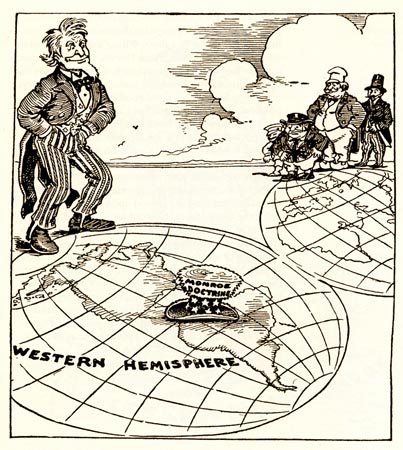
Political cartoon about the Monroe Doctrine, available in the Public Domain.
New Era of U.S. Intervention in Latin America
The Trump administration’s National Security Strategy marks a significant shift in U.S. policy toward Latin America.
The National Security Strategy (NSS) released by the Trump administration on December 4 marks a profound ideological shift in U.S. foreign policy. While the administration frames its “America First” doctrine as a “return to hemispheric defense,” critics and regional leaders view it as a pivot toward more assertive—and potentially interventionist—involvement in Latin American governance.
‘Trump Corollary’
The cornerstone of this shift is the introduction of the “Trump Corollary” to the Monroe Doctrine, reviving the 1823 principle that the U.S. will not tolerate malign foreign interference in its hemisphere.
Regional Preeminence: The strategy asserts that U.S. security and prosperity depend on being “preeminent in the Western Hemisphere.” It argues the U.S. has the right to intervene to prevent “hostile foreign incursions” (specifically targeting Chinese and Russian influence) and to secure critical supply chains.
“Enlist and Expand” Alliances: The U.S. plans to “reward and encourage” governments and political movements that align with its principles. This has already manifested in increased funding and support for ideologically aligned leaders, such as in Argentina.
Direct Security Intervention: The NSS moves away from a “law enforcement-only” approach to cartels, instead labeling them as “narco-terrorists.” This provides a justification for the use of lethal force in other countries.
Economic Leverage: The administration is using “commercial diplomacy”—including tariffs and the cutting of development aid—to coerce local elites into cooperating with U.S. objectives on migration and trade.
Interference vs. Cooperation
The NSS has ignited debate over whether the “Trump Corollary” represents a defensive necessity or a return to 19th-century-style interference. The White House argues it is a vital shield against Chinese infrastructure projects and Russian military presence in the region. Critics describe it as neo-imperialism.
Security Operations and Sovereignty
A major point of contention is the shift in counter-cartel operations. By reclassifying cartels as “narco-terrorists,” the administration justifies “lethal kinetic force” to stop a “fentanyl invasion.” By late December, the U.S. military conducted at least 30 strikes on vessels in the Caribbean and Pacific, resulting in at least 107 deaths. While the administration views these as surgical strikes against existential threats, critics see them as violations of national sovereignty that create a permanent combat zone.
Political Alignment and Coercion
The strategy’s approach to political support has created a rift. The U.S. “enlist and expand” policy is evidenced by a $20-billion support package for Argentina’s Milei administration and praise for leaders in El Salvador and Ecuador. While the White House frames this as strengthening democratic partnerships, skeptics see it as a tool to destabilize institutions in non-aligned countries. For instance, tariff threats against Brazil are viewed as attempts to force political shifts favoring the United States.
Economic Leverage as a Border Tool
The administration has linked trade benefits and aid to a country’s success in stopping migrant flows, arguing it is demanding “reasonable governance.” Critics, however, define this as economic coercion.
Recent Actions Under the Strategy
Since the strategy’s release, several high-profile actions have fueled concerns about a new era of interference:
- Military strikes on Venezuelan boats and seizure of oil tankers;
- Military plans for maintaining access to the Panama Canal;
- The pardon of former Honduran President Juan Orlando Hernández, previously convicted in the U.S. of state-sponsored drug trafficking;
- Tariffs on Brazil to challenge political positions.
Naming three threats in the Western Hemisphere – migration, drugs and crime, and China – the Trump administration asserts the right to strike its neighbors, potentially unleashing a new forever war.
For analysis of other parts of the NSS, read commentary by experts at Brookings.
Photo: Political cartoon about the Monroe Doctrine, available in the public domain via Wiki Commons.
