

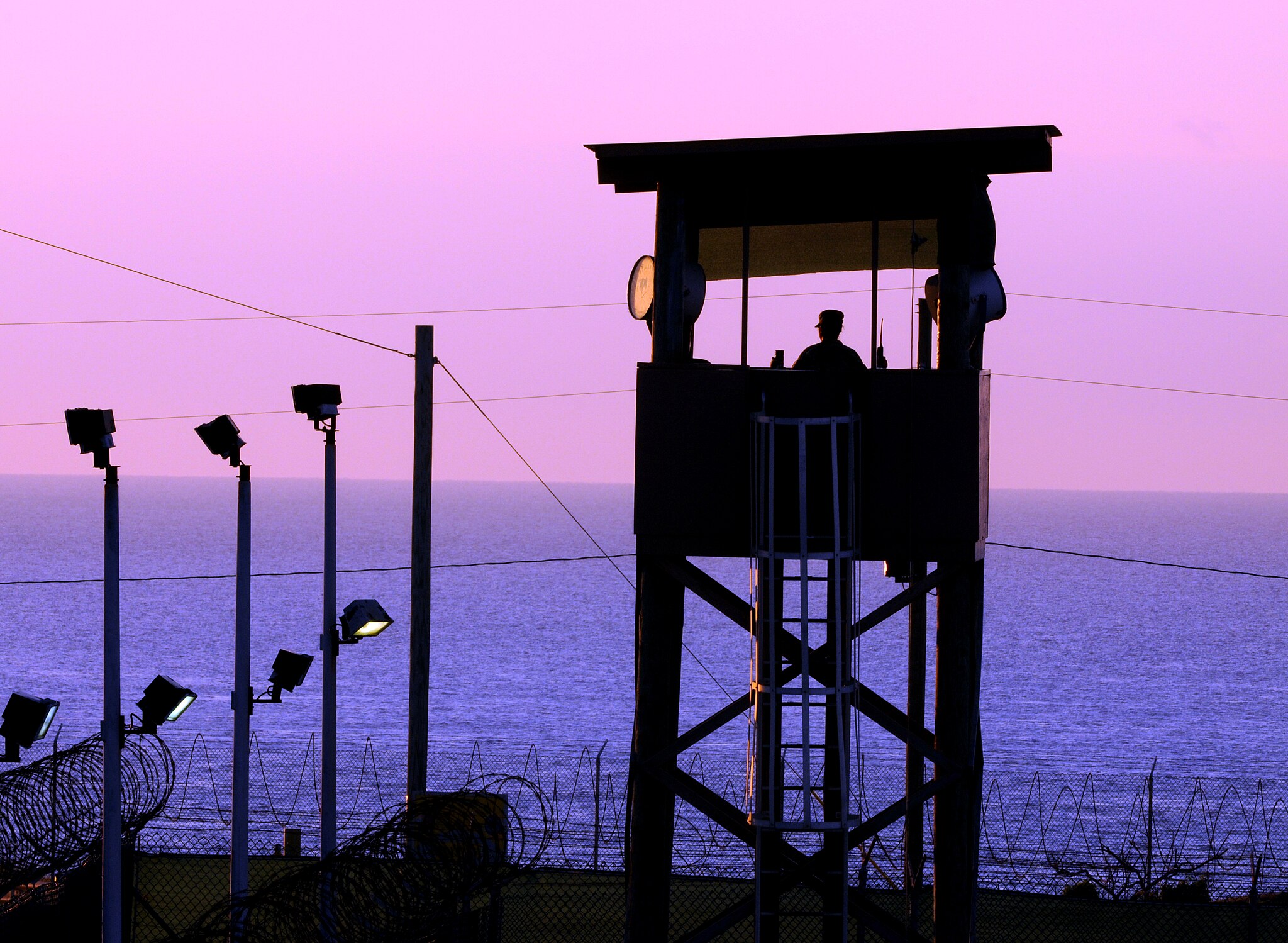
GUANTANAMO BAY, Cuba – Spc. Emely Nieves from the Puerto Rico Army National Guard guards her post over the Joint Task Force Guantanamo detention facility at sunrise. Photo by U.S. Air Force Senior Airman Gino Reyes and available in the Public Domain.
Close Guantánamo Before It Gets Worse
The Trump administration aims to send thousands of immigrants to the Guantánamo Bay Detention Center where fifteen men remain in indefinite detention, 24 years since the hidden and abusive prison opened.
January 11 marks the 24th anniversary of the opening of the post-9/11 U.S. detention facility at Guantánamo Bay, long synonymous with torture, indefinite detention, and the erosion of fundamental human rights. In early 2025, the Trump Administration said it wanted to be able to hold 30,000 immigrants at Guantánamo. Since them, about 700 immigrants cycled through detention at Guantánamo, held in either the military detention facilities portion of th base or the adjacent Migrant Operations Center.
Of the 779 people imprisoned there since 9/11, only 15 remain. Of the 15, three have been cleared for transfer and three have never been charged with a crime. Despite recent efforts to resolve these cases through plea deals, those agreements are currently off the table, leaving cases stuck in pre-trial hearings with no resolution in sight.
A Legacy of Controversy
Established by the George W. Bush administration after the September 11 attacks, “GITMO” was designed to hold suspected terrorists and “enemy combatants.” The U.S. government initially argued that neither domestic nor international law applied there, triggering decades of legal and human rights controversies.
The faith community’s fears regarding the use of torture by the U.S. military were confirmed in 2004 with the release of photos of prisoner abuse at Abu Ghraib in Iraq. One of the most infamous photos was of a man standing on a thin box, his head hooded and his fingers extended out, connected to electrical wires. In response, the National Religious Campaign Against Torture (NRCAT) was founded to expose torture at CIA “black sites” and Guantánamo and to call for the closure of these facilities.
Progress and Challenges
In 2014, after a decade of advocacy, the Senate Intelligence Committee released a report documenting post-9/11 torture. While the full 6,700-page report remains classified, a 500-page executive summary was released in the McCain-Feinstein Amendment. This legislation banned the CIA from using interrogation techniques not authorized in the Army Field Manual.
NRCAT has since expanded its mission to end solitary confinement in U.S. prisons. Under the UN’s “Nelson Mandela Rules,” solitary confinement exceeding 15 consecutive days is considered “prolonged” and may constitute torture. NRCAT now partners with the ACLU and their “Unlock the Box” campaign to advocate for the federal End Solitary Confinement Act, which seeks to ban the practice for youth and implement rehabilitative alternatives.
Recent developments underscore the urgency for speaking out against torture and closing GITMO, including deplorable conditions in ICE facilities, the deportation of immigrants to third-party countries, and the administration’s stated desire to detain up to 30,000 immigrants at GITMO.
Senator Tim Kaine of Virginia has introduced resolutions in the Senate seeking information on the human rights practices of six countries to which the U.S. has reportedly deported immigrants who have no ties to those countries. A similar resolution regarding El Salvador failed in 2025. Using a process under Section 502B(c) of the Foreign Assistance Act, a Senator can force debate and a vote to scrutinize and restrict security aid to countries engaging in “gross violations of human rights,” requiring the State Department to report on these issues.
Even if the resolutions fail, they allow Senators to raise concerns on the floor about sending immigrants to places where they may be tortured. NRCAT has issued an action alert urging supporters to contact their Senators about it.
Speaking on Human Rights Day, Rev. T.C. Morrow, a United Methodist minister and NRCAT organizer, reflected on the spiritual and historical figures who fought for human dignity, from Moses and Isaiah to Gandhi and Eleanor Roosevelt, as well as current unsung heroes like pro bono lawyers, witnesses who record ICE arrests on their phones, and “survivors themselves who have shouldered the weight of detention and still turn towards life time and again.”
“The long arc of human rights work is carried by ordinary people making moral choices every day,” Rev. Morrow said. “Faith communities have always been a part of that arc, insisting that dignity is not optional.”
NRCAT is co-sponsoring vigils and rallies nationwide on January 11 and regularly on the first Wednesday of each month. If your religious organization would like to host or co-sponsor a Close Guantánamo event or to receive a “Close Guantánamo” banner, please contact Rev. T.C. Morrow, at tmorrow@nrcat.org.
FAITH IN ACTION: Visit nrcat.org to join advocacy campaigns and to find resources for Torture Awareness Month in June.
Photo: Guantanamo Bay watch tower, available in the public domain via Wiki Commons.
