
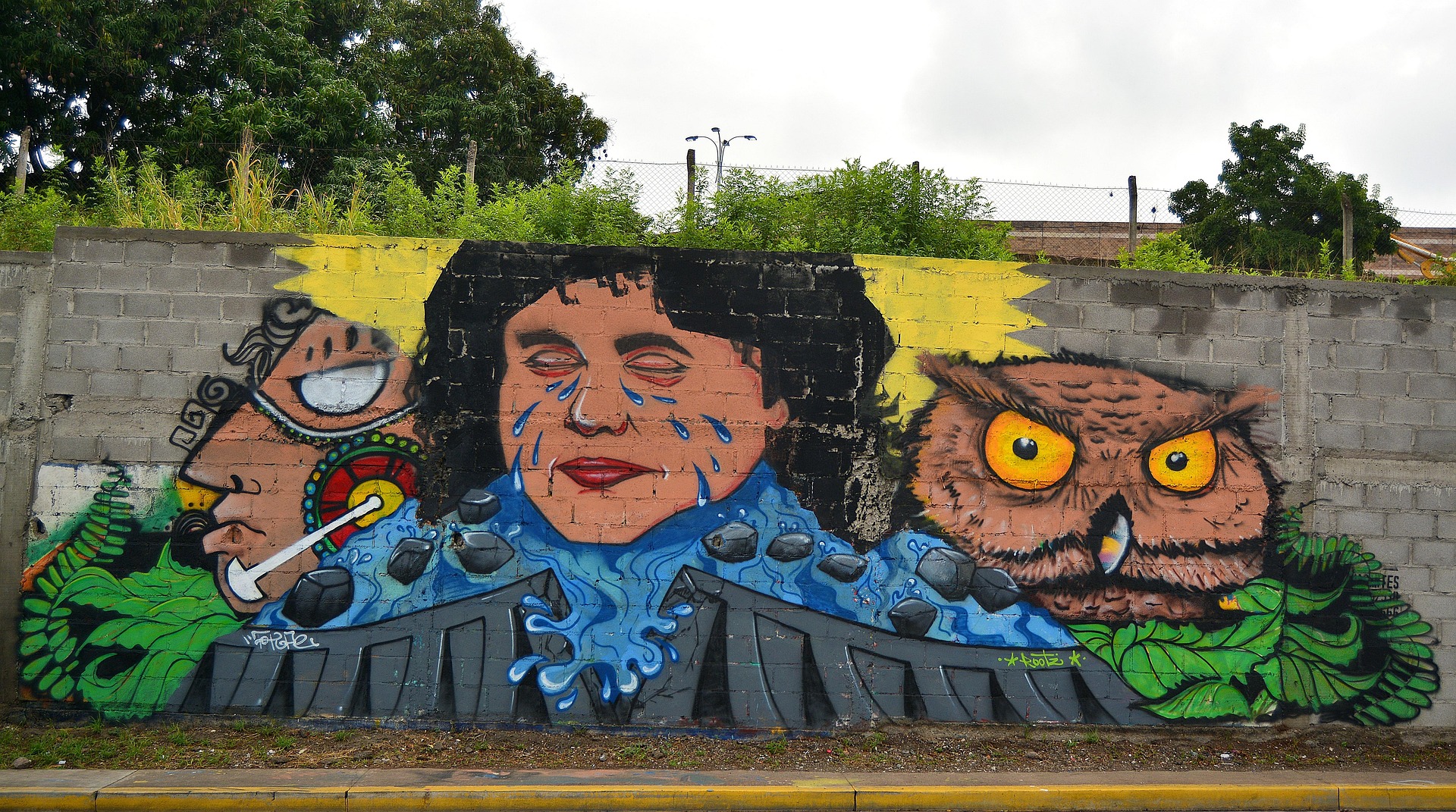
Mural honoring Berta Cáceres, an assassinated Honduran indigenous and environmental leader, available in the Public Domain.
Honduras at a Crossroads
With a dramatic, chaotic ending to the recent presidential election, Honduras is navigating the collision of corporate lawsuits, historical corruption, and the urgent struggle for democracy.
After nearly a month without a winner of the November 30 presidential election, the Trump-backed candidate Nasry “Tito” Asfura was declared president of Honduras by a razor-thin margin of 40.3% to Salvador Nasralla’s 39.5%. After delays due to technical issues and reported threats from President Trump to withdraw financial support to Honduras if Asfura didn’t prevail, the results remain disputed. The president of the country’s Congress, Luis Redondo, has called the election results “completely illegal” while outgoing President, Xiomara Castro, has alleged an “electoral coup”.
In response to this fraught moment, international huma rights organization Global Exchange and its Honduran partner, the Center for the Study of Democracy (CESPAD), released a report on December 16, Honduras Under Siege: Anatomy of an Electoral Intervention and the Path Toward Democratic Resistance, based on findings from international and national election observers.
The Legacy of the “Narco-Dictatorship”
The report contextualizes the current crisis in the 2009 coup and the subsequent twelve years of National Party rule under Juan Orlando Hernández (JOH), which Global Exchange describes as a “narco-dictatorship” that hollowed out state institutions for transnational criminal interests. Although JOH was extradited to the United States and convicted on drug trafficking charges in 2024, the report emphasizes that the structural corruption and “mafia-style” networks established during his tenure remain deeply embedded in the Honduran judiciary, military, and police. President Trump pardoned JOH on Dec. 1, 2025.
Corporate Lawsuits and “Parallel Justice”
The report highlights “corporate assault,” detailing how transnational corporations use the Investor-State Dispute Settlement (ISDS) mechanism in trade deals to sue the Honduran government. Often brought before the World Bank’s International Center for Settlement of Investment Disputes, these lawsuits target the government’s attempts to repeal JOH era laws, most notably the “Zones for Employment and Economic Development” (ZEDEs).
Human Rights and the Plight of Defenders
The report paints a grim picture of the safety of those who oppose these corporate and criminal interests. Honduras remains one of the most dangerous countries in the world for environmental and land defenders. Global Exchange specifically points to the September 2024 murder of Juan López, a prominent environmental activist who organized against mining projects in Tocoa.
The “siege” described in the title refers to the constant intimidation, criminalization, and assassination of Garífuna, Indigenous, and campesino leaders. Despite the reformist rhetoric of President Xiomara Castro’s administration, the state has been unable to dismantle the paramilitary groups and private security forces that protect extractive projects.
U.S. Interference and the 2025 Elections
Global Exchange criticizes recent statements by U.S. political figures, including President Trump and members of the House Foreign Affairs Committee, arguing that labeling the Honduran government as “communist” or “unreliable” revives right-wing “strongman” politics, undermines Honduran sovereignty, and risks delegitimizing elections.
Social and Environmental Fragility
The report also touches on the intersection of climate change and migration. With the “Dry Corridor” suffering from erratic rainfall and Tropical Storm Sara causing widespread devastation in late 2024, the report links environmental collapse to the “push factors” of migration. It argues that as long as corporate “mafias” control natural resources and water, local communities will remain unable to sustain themselves, fueling migration.
Recommendations
The report concludes that Honduras is trapped between the desire to reform and a pushback from international capital and domestic elites. To break this “siege,” Global Exchange recommends that Honduras withdraw from international arbitration treaties that prioritize profits over human rights; abolish ZEDEs to restore full national sovereignty; establish an independent mechanism to protect human rights defenders; and prosecute those responsible for the murders of activists, and urges the international community, especially the U.S., to respect Honduran sovereignty and allow fair elections.
Global Exchange’s report serves as both a warning and a call to action to stand with the Honduran people in their struggle for democracy and dignity.
Photo: Mural honoring Berta Cáceres, an assassinated Honduran indigenous and environmental leader, available in the public domain via Pixabay.
_(Suluhu_crop).jpg)