
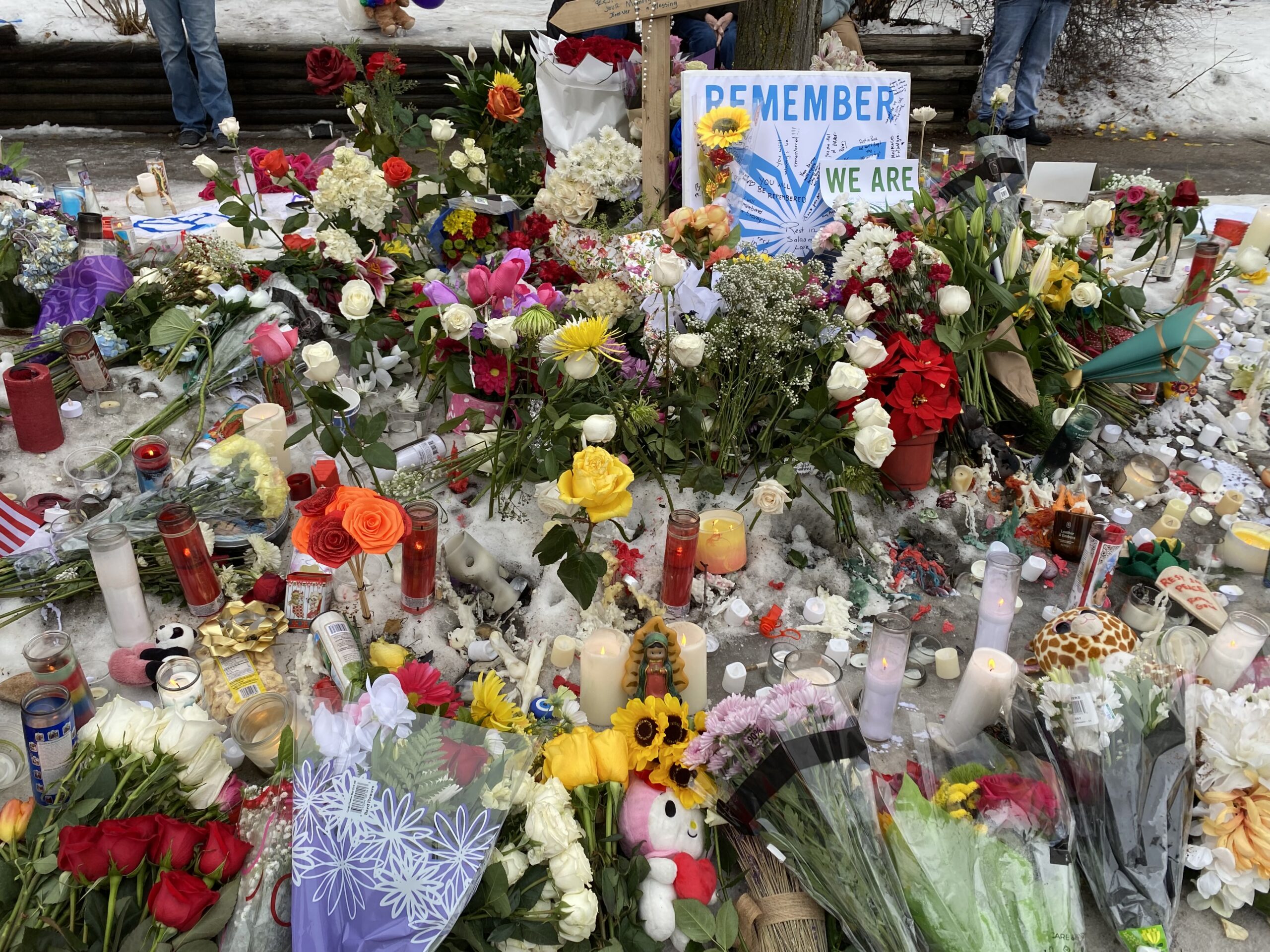
Curbside memorial in Minnesota. (Greg Darr)
Witnessing ‘Neighborism’ amid the Siege of Minnesota
As U.S. federal immigration enforcement turned violent, a civic culture of “neighborism” emerged in the Twin Cities. Greg Darr, Vocations Minister for the Maryknoll Fathers and Brothers, reports from Minnesota.
Minneapolis – the “City of Lakes” – has become, in recent years, more poignantly known for its curbside memorials – riotous islands of flowers, votive candles, signs, poetry, letters, teddy bears and photos that mark the open, communal wounds left by armed violence. One still flourishes from the 2020 killing of George Floyd by police. Another remains, in part, from last year’s mass shooting that killed two children and wounded thirty others at nearby Annunciation Catholic Church.
Two more curbside memorials have emerged in the weeks following the violence of “Operation Metro Surge”; one for Renée Good, the other for Alex Pretti. Their shooting deaths, roughly two weeks apart in January, by Immigration and Customs Enforcement (ICE) agents, are a tragic addition to Minneapolis’ story.
Both Ms. Good and Mr. Pretti were 37 years old and U.S. citizens. Both were nonviolent legal observers acting within their constitutional rights to witness and document ICE’s violent actions. Both sought to protect their immigrant neighbors. And, in the wake of their killings by ICE agents, both were labeled by the federal government as “domestic terrorists”. Their curbside memorials, however, tell a different story – one of compassion and concern for the welfare of their immigrant neighbors. And, they point to a different way forward for our communities and our nation.
Operation Metro Surge represents the largest influx of armed federal forces against a U.S. state’s residents since the Civil War. Starting on Dec. 1, 2025, it promised, in President Trump’s words, to bring “reckoning” and “retribution” to the people of Minnesota. By January 26, some 3,000 federal agents were active in the state, largely concentrated in the Twin Cities– more than the combined police forces of Minneapolis, St. Paul and nearly a dozen nearby suburban departments. The operation also drew unprecedented levels of government-sanctioned violence and economic upheaval to communities throughout the state.
The Surge also sparked something else – a completely organic grassroots-initiated outpouring of support for Minnesota’s immigrant communities and those protecting them. This support includes rallies, rapid response teams and mutual aid organized by a coalition of churches, schools and businesses. Over 30,000 Minnesotans have trained as legal observers, with artists lending creative vision to the movement. Among these efforts is Leo’s Towing, a small company that returns, free of charge, vehicles abandoned on roadways after drivers are seized by ICE. Another initiative, “Haven Watch Minnesota”, accompanies those released from detention into the extreme cold, often at night, without ID, money, phone or a way home.
As political leaders faltered, ordinary citizens stepped into the void. Whether acting on a single street or across the state, Minnesotans report that their primary motivation isn’t just ‘protecting democracy’—it is the deeply personal experience of finding community. My own parish, St. Joan of Arc Catholic Community, recently saw participation double in its “Welcome the Stranger” ministry. In reaching out to immigrant neighbors, new participants are discovering multiple ways to serve alongside a renewed sense of purpose, community, and even joy. Adam Serwer of The Atlantic summed up, “If the Minnesota resistance has an overarching ideology, you could call it “neighborism”—a commitment to protecting the people around you, no matter who they are or where they came from… Minnesotans are insisting that their neighbors are their neighbors whether they were born in Minneapolis or Mogadishu. That is, arguably, a deeply Christian philosophy, one apparently loathed by some of the most powerful Christians in America.“
Following Renée Good’s death, I visited a Somali-owned shop selling items from their culture. As a white Minnesotan and returned Maryknoll Lay Missioner in East Africa, I have always felt at home there. As I reached for a small flag of Somalia, the shop owner interrupted me, saying, “That flag is my gift to you. But, if you are going to take it, then you must also take this one.” He then reached into his overflowing bin of banners and, to my surprise, pulled out an American flag. He put it in my hand, saying, “Brother, this is the flag of our home – yours and mine. You cannot take that flag without taking this one. This one shows we are family.”
Like the flags at curbside memorials in Minnesota, we each bring our own remembrance to these uncertain times. The result may appear chaotic, but it’s in these places that the grieving experience consolation, the seeking find hope, and we discover, among our neighbors and family.