

Letter to Congress on Homeland Security Appropriations
Twenty-seven faith and civil society organizations, including the Maryknoll Office for Global Concerns, sent the following letter to Congress expressing our concern about the Department of Homeland Security’s budget.
Dear Members of Congress,
We commend your continued leadership in securing Fiscal Year 2026 funding for the federal government, including critical resources to uphold national security and ensure immigration laws are enforced humanely. However, we are deeply alarmed by the Department of Homeland Security’s (DHS) growing and unchecked budget. As faith-based organizations, we are concerned about the direction of the Department’s budget and enforcement priorities. DHS’ actions disregard due process and civil rights and liberties, leading to a historic number of fatalities both on the streets and within facilities. Immigration and federal law enforcement agents have invaded residential neighborhoods and private businesses, struck fear into sacred spaces, and hidden behind opaque budget transfers in the name of mass deportation goals. As appropriations leaders conference the Fiscal Year 2026 Department of Homeland Security Appropriations Act, we respectfully urge your discernment in reconciling a final bill that ensures faithful stewardship of taxpayer funds and stronger accountability and oversight.
Before highlighting areas for improvement in the bill, we wish to first express our gratitude for several provisions included in the current Senate majority proposal. We appreciate the overall gesture toward auditing and reasserting congressional authority. The bill and committee’s emphasis on reporting data related to the “One Big Beautiful Bill Act” (P.L. 119-21) is an important step toward transparency and accountability (Sec. 217 and 219). It would be helpful if this information was shared with the public. We also commend the Senate’s inclusion of several provisions that guard against inhumane enforcement practices. Namely, Sec. 213 (Sec. 217 in the House bill) would help uphold higher standards of care in DHS detention facilities by preventing funds from going toward contracts that receive two poor performance evaluations from the U.S. Immigration and Customs Enforcement Office of Professional Responsibility. This is a crucial step following the dissolution of the Office of Detention Ombudsman; however, it would be misguided to eliminate the independent detention ombudsman altogether.
The committee’s recommendation of $245 million for the Office of Inspector General (OIG) is also notable. For every $1 dollar dedicated to OIG, the department is saving $27.26 in waste, fraud, and abuse. We are also appreciative of Sec. 527 and Sec. 528, reaffirming the detention inspection oversight authority of members of Congress and restrictions on physical restraints during enforcement of pregnant and post-partum women, to protect their safety and wellbeing. These are meaningful measures that affirm life and renew our commitment to core American values.
Additionally, the committee’s reporting requirements regarding immigration enforcement at or near sensitive locations is commendable but leaves room for violations of religious freedom and expression (pg. 65). Finally, while general limits on transfer authority are imposed (Sec. 503), more is needed to rein in large-scale fiscal mismanagement plaguing the agency, as repeatedly flagged by House congressional appropriators. Concerningly, this provision does nothing to prevent unchecked transfers for detention operations, giving Immigration and Customs Enforcement (ICE) a backdoor to more reckless spending.
With these concerns and more in mind, we offer the following proposals to ensure the Homeland Security bill reflects the public interest:
- Enforceable Consequences for DHS Failures – Require that appropriated funds can only be expended if the DHS Secretary meets annual efficiency reviews as well as reporting requests from respective committees or OIG, or otherwise provides due and reasonable justification for lapses. Require compliance with congressional reprogramming guidelines and make transfers of detention operations subject to reprogramming guidelines.
- Oversight & Accountability – Include authorization language upholding the crucial oversight functions of the Citizenship and Immigration Services Ombudsman, Immigration Detention Ombudsman, and the Office of Civil Rights and Civil Liberties. Continue to include language that mandates the swift and thorough reporting of any deaths that happen under the custody of ICE and any other DHS agency.
- Backlog Reduction – Allocate $271.14 million for Operations and Support at U.S. Citizenship and Immigration Services to ensure that the agency can operate its internal infrastructure and efficiently process immigration applications.
- Access to Naturalization – Continue funding the Citizenship and Integration Grant Program at $10 million, allowing lawful permanent residents to access naturalization.
- Protect Flores Agreement – Require that no funds appropriated be used to terminate the Flores Settlement Agreement. Although no amount of detention is suitable for a child, limiting any form of child detention or family detention is an essential step toward the goal of eradicating child detention altogether.
- Stipulate Guidance at Places of Worship, Schools, Hospitals – Reestablish guidance on ICE’s conduct at or near sensitive locations. Following the January 2025 rescission of the protected areas guidance, numerous arrests have occurred at places of worship. These actions restrict religious freedom and create fear of indiscriminate enforcement in faith communities. Enforcement actions discourage participation in essential religious services, and have, in some cases, limited community members’ access to life-sustaining resources and support from their faith communities.
- Ensure Access to Religious Services in Detention – Include committee language asserting the importance of accommodating detainees’ religious practices, including essential rituals and sacraments. Several priests, Sisters, bishops, and religious leaders seeking to provide Communion and spiritual care to the people detained have been denied access.
- Prioritize Accountability Mechanism – Reject increased funding for unchecked ICE detention and enforcement, and instead reallocate resources for more robust transparency, oversight, and accountability measures for ICE and CBP.
The manner in which the Department exercises its authority profoundly impacts lives and communities. Despite mounting evidence of DHS’ worsening detention conditions, Congress is preparing to reward ICE with $6.2 billion in 2026 for an additional 50,000 detention beds. This comes on top of the 100,000 beds funded in the “One Big Beautiful Bill Act,” passed less than a year ago. Congress is also poised to endorse the largest deputization of federal law enforcement for immigration enforcement in history—an investment larger than most nation’s defense budgets. This would undoubtedly carry significant ramifications for the Department of Justice and Department of Defense, which have other priorities and responsibilities. Taxpayers should not bear the cost of rewarding DHS for its litany of abuses and unchecked powers.
The conference period is an opportunity to put forth a bill that exercises Congress’ authority. Escalating, reckless enforcement efforts are causing too many of our neighbors to abstain from exercising their religious freedom or accessing basic services. Credible reports of suffering and abuse within detention centers remind us that without vigilant oversight, the dignity and well-being of those held will continue to worsen. Our faith calls us to uphold the equal dignity of every person, regardless of status or origin. The safety of our communities depends on our institutions’ commitment to honoring life and ensuring dignity and respect for all. Thank you for your attention, and we are eager to remain engaged with your offices as you resolve the remaining appropriations bills.
For questions or concerns, please contact Giovana Oaxaca, Senior Government Relations Manager at NETWORK Lobby for Catholic Social Justice (goaxaca@networklobby.org), and Anika Forrest, Legislative Director for Domestic Policy at the Friends Committee on National Legislation (aforrest@fcnl.org).
Sincerely,
Alliance of Baptists
American Baptist Home Mission Societies
American Friends Service Committee (AFSC)
Arizona Faith Network
Congregation Dor Hadash
Congregation of Our Lady of Charity of the Good Shepherd, U.S. Provinces
Evangelical Lutheran Church in America
Faith in Public Life Action
Franciscan Action Network
Franciscan Peace Center, Clinton, Iowa
Friends Committee on National Legislation
Hope Border Institute
Interfaith Alliance
Jewish Coalition for Immigrant Justice NW
Justice and Advocacy Ministries at Disciples Home Missions
Kino Border Initiative
Leadership Conference of Women Religious
Maryknoll Office for Global Concerns
Missionary Oblates of Mary Immaculate
Multifaith Initiative to End Mass Incarceration
National Advocacy Center of the Sisters of the Good Shepherd
NETWORK Lobby for Catholic Social Justice
Pax Christi USA
Presbyterian Church (USA), Office of Advocacy and Witness
Sisters of St. Francis of Penance and Christian Charity, Holy Name Province
Unitarian Universalists for Social Justice
United Church of Christ
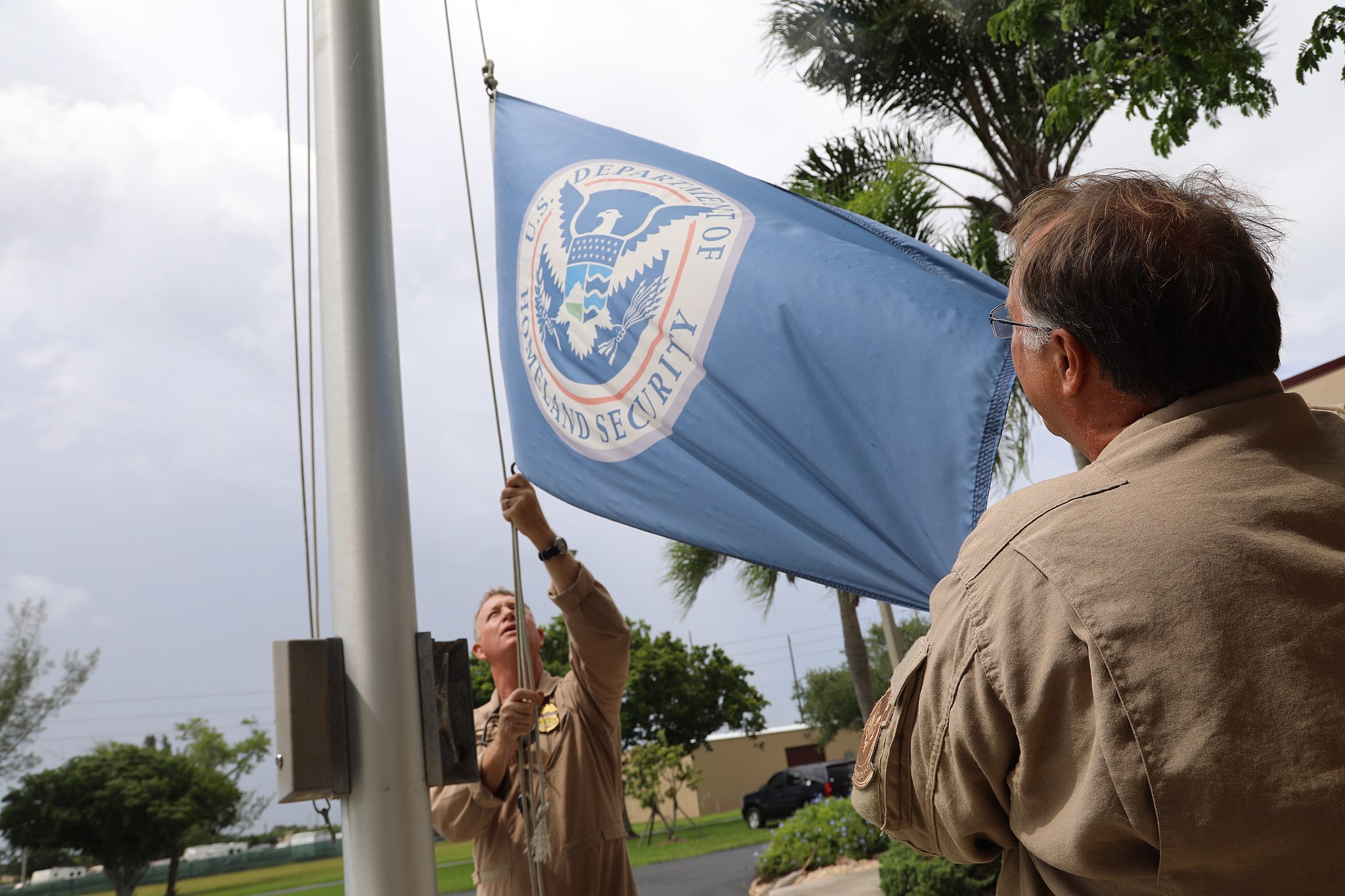
Photo: Agents lowering the DHS flag, taken September 1, 2019 by CBP Photography and available via Wikimedia commons, CC BY-SA 4.0.
