
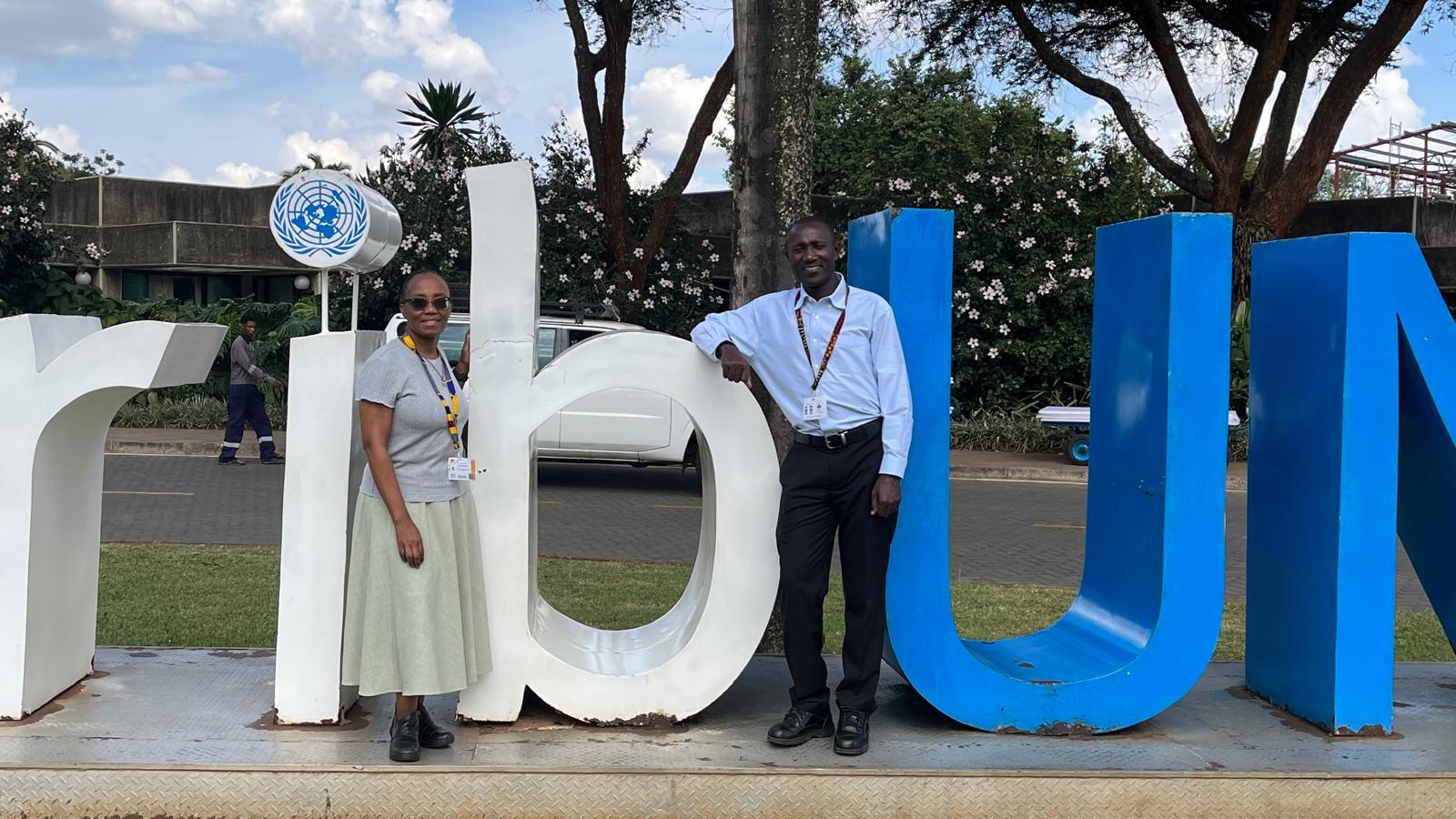
Maryknoll Sr. Susan Nchubiri with Maryknoll Fr. Patrick Okok at the UN Environmental Assembly, personal photo.
The Wind Beneath My Wings for Care for Creation
Maryknoll Sr. Susan Nchubiri delivered the following remarks about environmental advocacy during a side event at the UN Environmental Assembly in Nairobi, Kenya, on Dec. 4, 2025.
I speak today as an African Catholic woman. My African and Catholic belief systems shape my reflections on the care of the natural environment and all people. These two are the wind beneath my wings.
Growing up in the village, my mother and grandmothers told us stories about the interconnectedness and interdependence of people, nature, and the Supreme Being, the creator of everything. For example, among the Meru people, if the rains failed, the Mugwe (Seer) would involve the community in a rain-making ceremony. The community would choose an unblemished lamb or goat, a gourd of honey, various plant seeds to be blessed, and a few members would accompany the Mugwe to the sacred sites. He would lead the group in prayers for forgiveness and blessing. Part of the ceremony included planting small amounts of honey in castor oil sticks along the riverbanks. By the time they returned home from the ritual, it would be raining.
As a child, I remember following women and girls to collect firewood from the hills not far from my home. The adult women would tell us not to cut any green branches, saying that we needed to let them grow.
Unfortunately, this is no longer the case. When I go to the village, I feel sad that those beautiful hills have no more vegetation. All you see are red gullies and rocks. We can attribute this, of course, to population growth, modernization, the use of charcoal for cooking, greed and shortsighted political leaders, and a population that does not adhere to its traditional values of care and non-extraction.
I also remember how the sound of the river near my home soothed me while I slept and how I would go and sit with my feet in the water to sort things out in my head. The river, for me, acted as a healer and counselor. Today, one can hardly hear that sound because water levels have drastically reduced due to deforestation and a few political leaders diverting it to their farms, leaving very little for those downstream.
My Catholic faith teaches me to view the natural world as a gift and every person as God’s image and likeness, and therefore, I must love and respect them. Love entails care, protection, and nurture.
At the Maryknoll Office for Global Concerns, we take the integrity of creation and the care of our common home very seriously. As missioners, we have learned from the people among whom we live and work about best practices for advancing peace, justice, and the integrity of creation. The Maryknoll Sisters, a Catholic congregation of religious women missioners, to which I belong, have discussed the different stages of what we now call One Earth Community for over 20 years. In 2002, at their 15th General Assembly, the Sisters reflected on and discussed the theme “Mission: Evolving Towards a Global Community.” Although the Sisters had been involved in caring for the environment for years before, it was at this assembly that they explicitly stated their oneness with the cosmos and the imperative to change our attitudes. They resolved to:
- Develop a new understanding of justice as a right relationship between humans and the rest of creation, moving from a human-centered to an earth/cosmos-centered perspective.
- Create sacred spaces to share our diverse experiences of the Divine, so that we may deepen our communion and be a healing presence within the cosmos.
- Desire to own the deeper knowing that we carry within us of the oneness and interconnectedness of all creation.
- Create collaborative approaches that enable multifaceted responses to emerging mission challenges and foster a sense of community that reflects the diversity of all people of God.
- Desire to be a community that exercises faithful stewardship of its resources in a spirit of solidarity with each other and the poor, living in harmony with all creation.
- Subsequent assemblies have further deepened these commitments and directives to live the spirit of One Earth community and work tirelessly to preserve it.
In 2015, Pope Francis issued an encyclical on the environment called Laudato Si, in which he called Catholics and people of goodwill to examine our conscience on “what kind of world we want to leave those who come after us?” (LS#160). He called us to an ecological conversion that
- Expressly addresses social exclusion and environmental devastation and degradation.
- Denounces “the idea of infinite or unlimited growth, which proves so attractive to economists, financiers and technology experts. Based on the lie that there is an infinite supply of the earth’s goods, which leads to the planet being squeezed dry beyond every limit.” (L S, #106)
- Opposes the illusion of domination and extraction of all Earth’s resources, with the spiritual vision of the Bible that celebrates our interconnectedness with Earth and the responsibility to care for our common home, “The Gospel of creation.”
- Radically acknowledges that the struggles for justice for Earth and justice for impoverished people are not only connected, but are in fact the same struggle.
- Calls for “every effort to protect and improve our world entails profound changes in ‘lifestyles, models of production and consumption, and the established structures of power which today govern societies.’” (L S, #5)
Photo: Maryknoll Sr. Susan Nchubiri with Maryknoll Fr. Patrick Okok at the UN Environmental Assembly, personal photo.