
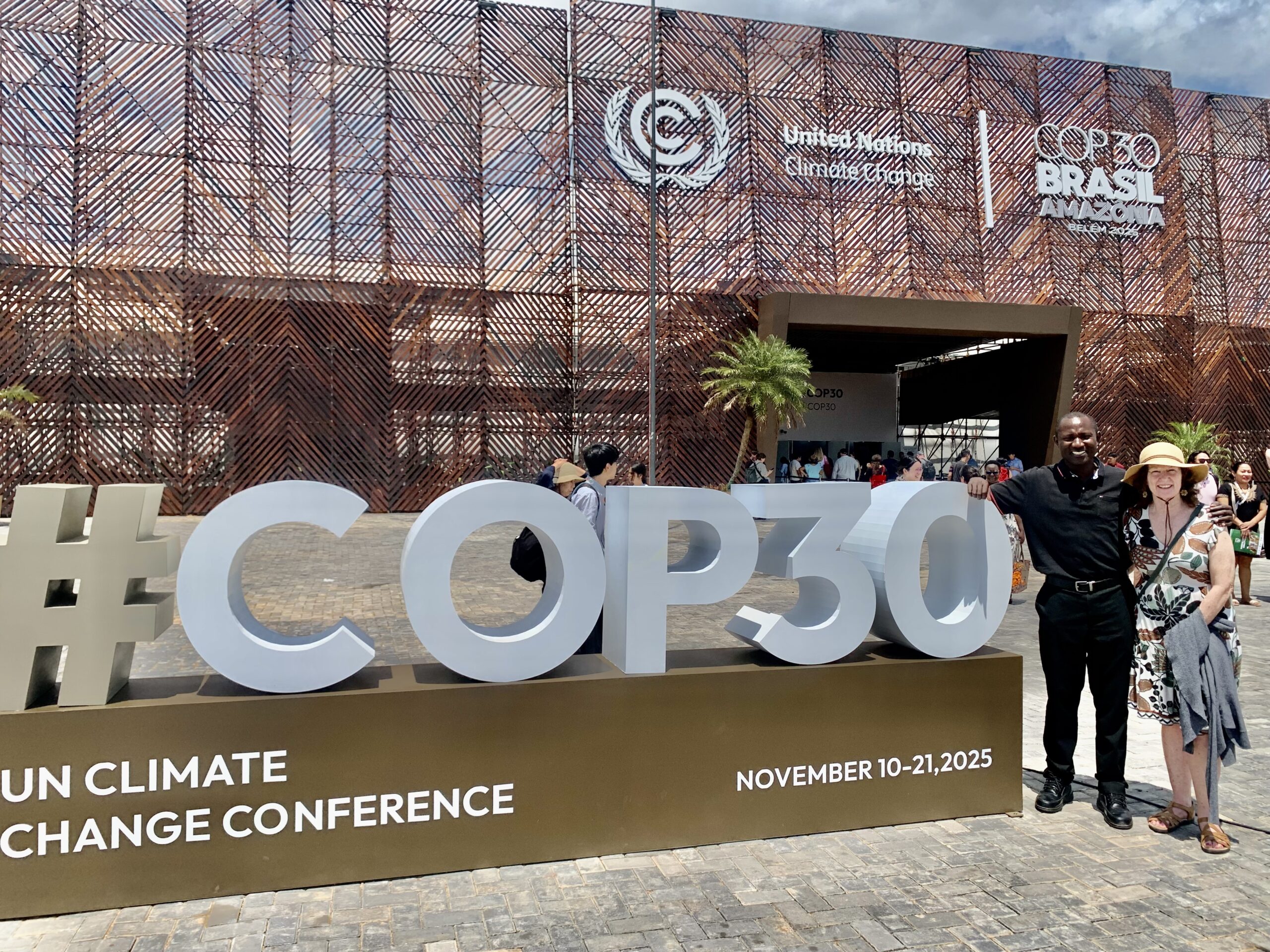
Lisa Sullivan and Maryknoll Fr. Patrick Okok at COP30, personal photo.
Maryknoll at COP30 in the Amazon
Two Maryknoll representatives report on the UN Climate Change Conference in Belem, Brazil.
Each afternoon in Belém, the skies over the Amazon opened without warning. Torrential rains drummed on canvas roofs and flooded corridors, sometimes forcing meetings to pause mid-sentence. Heat and humidity pressed in from all sides. In a city shaped by rivers and rainforests, nature poignantly took center stage at COP 30.
COP30 is the 30th Conference of the Parties to the United Nations Framework Convention on Climate Change, the global treaty where nearly every nation meets annually to negotiate collective responses to climate change. It took place in Belém, Brazil, at the edge of the Amazon Basin—one of world’s most climate-critical and climate-vulnerable regions. A decade after the Paris Agreement established a framework to limit catastrophic warming, governments, civil society, and faith communities arrived amid climate-driven droughts, floods, and heat that cause lost homes, food, and lives —and with further delay only multiplying losses.
The official outcomes of COP30 fell short of the actions needed to prevent these escalating losses. While final texts acknowledged the gravity of the climate crisis and almost 80 countries pushed to include a roadmap to phase out coal, oil, and gas, a few fossil-fuel-producing nations blocked its inclusion in the final text. Despite overwhelming scientific consensus that they are primary drivers of climate change, the words “fossil fuels” were ultimately absent from the agreement, underscoring the persistent political obstacles that continuously delay urgent, decisive action.
“This COP left us with an outcome that refuses to confront the fuel feeding this global fire and withholds the financial resources needed to put the flames out,” said Lisa Sullivan of the Maryknoll Office for Global Concerns.
At the same time, COP30 reaffirmed the value of multilateral climate cooperation. Despite the absence of a U.S. delegation, all other countries remained engaged. The UN climate process is slow and imperfect, but remains the only forum where nations collectively confront this shared threat—and where global temperature trajectories have, albeit modestly, avoided worst-case scenarios.
Maryknoll was represented by Lisa Sullivan and Maryknoll Fr. Patrick Okok, originally from Kenya, whose participation brought a pastoral and Global South perspective. Reflecting on his experience, Fr. Okok called COP30 “an eye opener,” especially in witnessing so many nations confronting the reality of rising global temperatures together. Fr. Okok also observed that leaders from the Global South consistently emphasized a familiar imbalance: countries that have contributed least to climate pollution are suffering the most.“We all see the problem,” he reflected, “but unfortunately we’re not being aggressive enough to address it.”
Beyond official negotiations, Belém buzzed with parallel gatherings. Tens of thousands participated in the People’s Summit and the People’s Climate march, while faith celebrations, symposiums and processions filled the city. Bishops and cardinals led a procession and Mass honoring Amazon eco-martyrs, with youth carrying banners of Chico Mendez and Sister Dorothy Stang. These spaces reflected a growing form of grassroots multilateralism and shaped the launch of the Just Transition Mechanism, a framework ensuring that the global shift away from fossil fuels does not leave workers and vulnerable communities behind, centering people—especially those in the Global South—in the transition to clean energy.
Catholic engagement was especially visible throughout these efforts. Hundreds of Catholics representing organizations from around the world participated, including cardinals and bishops from Africa, Asia, Latin America, Europe, and Canada. A joint statement from the Bishops’ Conferences of the Global South emerged as a central moral reference point and was delivered to the COP 30 Presidency. Grounded in Catholic social teaching and pastoral experience, the statement called for climate action shaped by justice, solidarity, and care for creation. Maryknoll supported efforts to ensure that voices from frontline communities and church leadership were included in official COP spaces. Pope Leo sent a video message to clergy at COP30, saying “we are guardians of creation, not rivals for its spoils.” His words were a call for nations to take bold, decisive action in confronting the climate crisis, placing moral responsibility above political hesitation.
While COP30’s official outcome failed to address the urgency of the fossil fuel transition, alliances of the willing—nations, Indigenous communities, grassroots movements, and faith-based actors—are stepping forward. The First International Conference for the Transition Away from Fossil Fuels, convened by Colombia and the Netherlands on April 28–29 in Santa Marta, Colombia, will be a pivotal moment. It offers a platform for committed countries to coordinate, share strategies, and demonstrate that bold, multilateral, grassroots-driven solutions are achievable.
Faith in action
Watch our Amazon to Action COP30 debrief webinar.
Photo: Lisa Sullivan and Maryknoll Fr. Patrick Okok at COP30, personal photo