
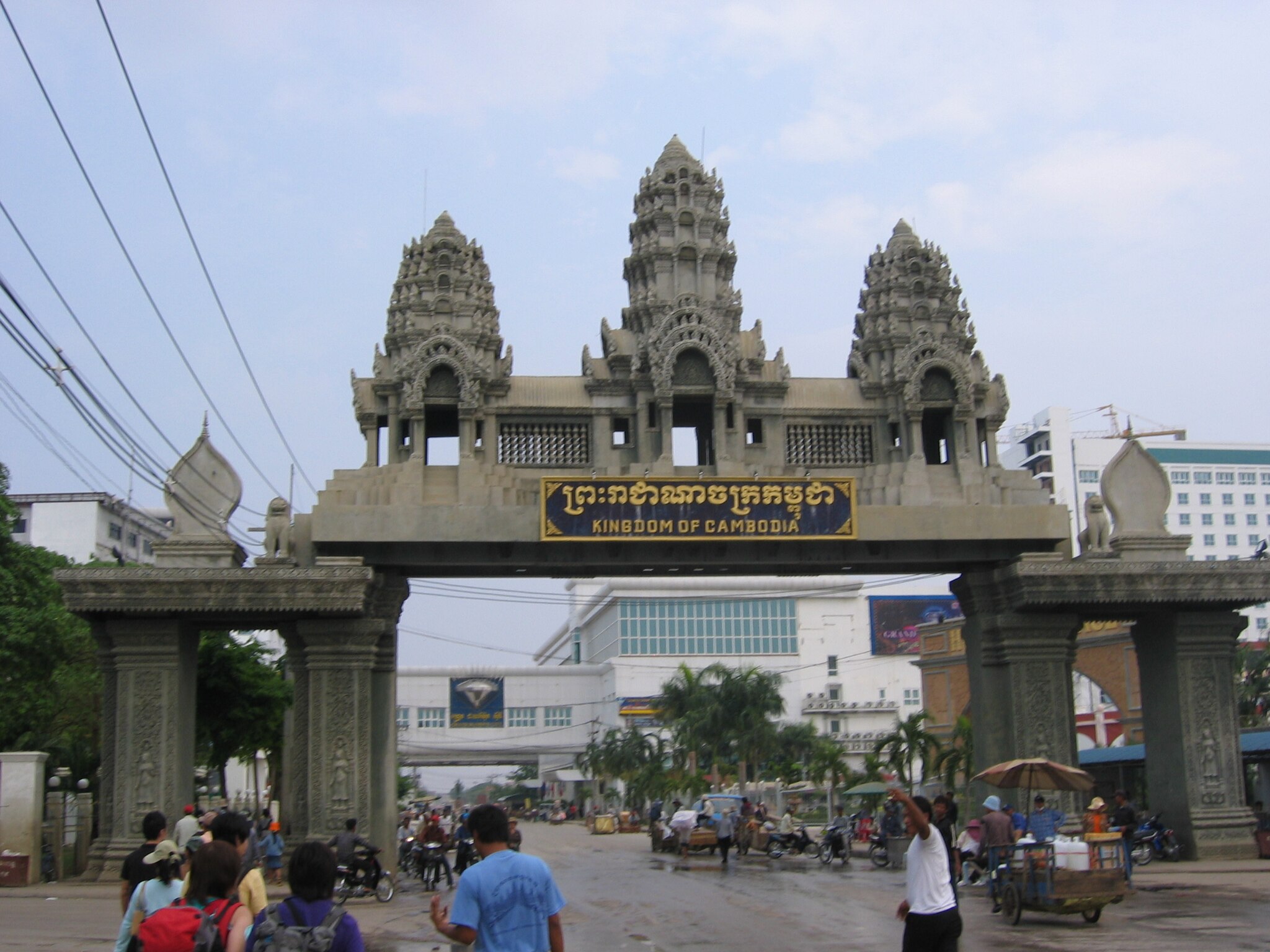
Poi Pet Border Gate at the Cambodia-Thailand border. Photo by gary4now and available via Wikimedia Commons license CC BY 3.0.
Cambodia and Thailand Land Conflict
Maryknoll lay missioner Hang Tran is in northern Cambodia providing care for people displaced by the recent violent border clashes between Thailand and Cambodia.
The root cause of the deadly clashes along the 508-mile land border between Thailand and Cambodia that has killed more than 30 people and displaced over one million goes back to colonial times when, in 1907, France drew the border between Siam (now Thailand) and French Indochina, which later divided into Vietnam, Laos, and Cambodia.
The primary flashpoint is the area surrounding the Preah Vihear Temple, a UNESCO World Heritage site, located on a mountain range that provides a natural border between the two countries. After Cambodia gained independence from France in 1953, Thai forces occupied the temple. Cambodia took the case to the International Court of Justice (ICJ) in the Hague, which ruled in 1962 that the temple itself belonged to Cambodia but left the surrounding area undefined, creating a contested zone that remains disputed. This ambiguity creates what Thailand calls the “disputed area” and what Cambodia considers its integral territory.
While the territorial dispute is the root cause, violent clashes have been triggered by specific political and nationalistic events. In 2008, Cambodia’s successful bid to register Preah Vihear as a UNESCO World Heritage site fueled nationalistic protests in Thailand. In 2025, the death of a Thai soldier who stepped on a landmine in the disputed zone led to ground fighting and airstrikes.
Although a comprehensive peace agreement was signed in October 2025, brokered by Malaysia, new border incidents occurred in early December, escalating into shelling, air strikes, and drone attacks. Both nations blame each other for initiating hostilities and claim self-defense.
Throughout, civilians on both sides of the border have borne the brunt of the violence. Hundreds of thousands of people have been displaced. Infrastructure, including hospitals, has been destroyed. Reports indicate that Cambodians working in Thailand have faced threats, while Thais have been assaulted by Cambodians in South Korea.
Meanwhile, the Catholic Church has strived to help the local populations, providing food and temporary shelter to thousands of families on both sides of the border fleeing the renewed fighting.
The Catholic Bishops’ Conference of Thailand has asked “all dioceses, religious orders, Catholic organizations, and all benevolent Christians to show love and compassion to our brothers and sisters who are suffering through donations according to their ability via Caritas Thailand.”
Across the border in Cambodia, Bishop Olivier Schmitthaeusler, the Vicar Apostolic of Phnom Penh, has asked parishes to organize Masses and prayer services imploring peace.
Pope Leo XIV appealed at his December 10 general audience for a swift resolution to the crisis.
“I am deeply saddened by the news of the renewed conflict along the border between Thailand and Cambodia, which has claimed civilian lives and forced thousands of people to flee their homes,” he said.
“I express my closeness in prayer to these dear peoples, and I call on the parties to immediately cease fire and resume dialogue.”
Caritas Cambodia has been collaborating with national and international organizations to provide emergency relief at 10 internally displaced persons (IDPs) camps. Recently, Maryknoll lay missioner Hang Tran joined a Caritas team in northern Cambodia to assist in three IDP camps hosted by local Buddhist temples. The services include temporary shelters, clean water, latrines, sanitation materials, and psychosocial care and support.
“My part was supporting emotional well-being through drawing and coloring. I made drawings of animals, houses, trees, etc. for the youth to color. In these moments, the kids were occupied with nature and familiar things that they can create with crayons and papers.”
Some of the children, Hang said, displayed symptoms of trauma from their experiences of hearing loud explosions and fleeing their homes in search of safety, such as difficulty sleeping or nightmares.
Some of the older adults are using skills they learned during previous wars. They can “recognize the directions of weaponry being fired by sound and were skillful in leading others to natural caves or underground bunkers for protection,” Hang said.
As of late December, tensions remain high, with Thai authorities seeking to repatriate up to 6,000 citizens stranded after Cambodia closed a key border checkpoint in the city of Poipet.
FAITH IN ACTION: Find updates from Maryknoll Lay Missioners in Cambodia at http://www.mklm.org
Photo: The Thai/Cambodia border, available in the public domain via Wiki Commons.
